Downloads for MAI machines
MAI System2000 tape file exchange
MAI System 210
System 510
MAI S/10
13xx CPU
13xx Boards
MAI basic four system history
On this page, i tried to collect information about systems from MAI
Basic Four i found or remembered.
I have also some files for MAI machines here.
Btw, i'm looking for a BOSS/IX tape or the contents of the tape for
my MAI system 2000 (BOSS/IX release 7.5B*22), if you have such a
tape
or know someone who may help me out, please contact me.
BB-I, BB-II - 1973? (BOSS)
The first systems were based on machines developed by Microdata
Corporation.
I only have a few information about these systems but the
schematics
for the cpu, the disk controller and a terminal (7220 and 7230)
are available at bitsavers.
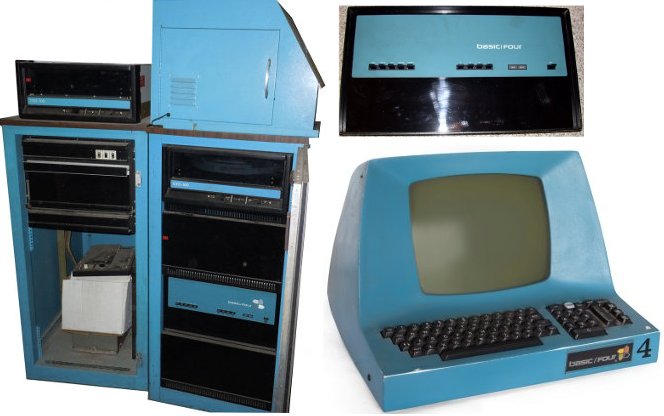
From the schematics, you can see that the Basic Four systems
schematic (LD1010_Model_1200_CPU_Logic_Diagrams_Aug73) equals the
Microdata 1600. The systems run an Businness Basic (BB-I and
BB-II)
operating system by Basic Four. MAI models were 400 & 600
models
eqiped with core memory. Rhode Island Computer
Museum has two models 1200
from 1976.
BB-III and BB-IV (BOSS)
The 110,200,310,410 series systems are 14" fixed disk systems based on either the Memorex 601 25/50/75
MB fixed disk (200,410) or the Priam P33,P66,P154
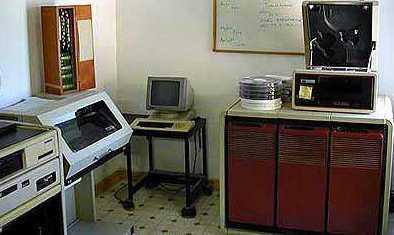 fixed disk (110,210 (see pictures),310). Information about the priam drives
(3350,6650 and 15450) is available on bitsavers.
(Product
description OEM
Manual) The 1600 system is a 5 1/4" fixed disk system. Disk
drives used may be Rodime,
Micropolis,
or Maxtor.
fixed disk (110,210 (see pictures),310). Information about the priam drives
(3350,6650 and 15450) is available on bitsavers.
(Product
description OEM
Manual) The 1600 system is a 5 1/4" fixed disk system. Disk
drives used may be Rodime,
Micropolis,
or Maxtor.
There were two cpu's available for these systems: 132x (slow speed)
and 135x (lightning) CPUs (510, 610, 700 & 730).
As the BB1 and BB2, BB3 and BB4 were businness basic only machines.
The basic was
powerful and contained keyed file (INDEX and SORT) that worked with
hashes CHECK. The disk
format used some kind of SORT file for the dictionary
(sorted by sector number). When a file had to be created, the
starting
sector number and the size had to be specified. All files where
fixed
length files.
I'm looking for the following documentation (or other interesting
ones like service manuals) to scan these:
- 1300 CPU Technical Manual
- M1300 Series CPU Organisation and Description Reference Manual
-
- 610/730 SERVICE MANUAL
S/10 - 1982 (BBX and CP/M)
The MAI S/10 was a Z80 based machine developed by Direct Inc as a
CP/M
machine as well as a VT terminal. The machine was capable of running
BB/M by MAI or CPM 2.2. The desktop sized machine contained an
integrated screen as well as two 5 1/4" 80 track double sided
floppies.
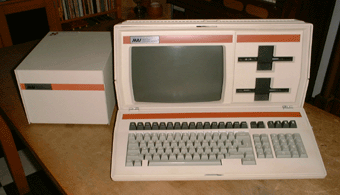 One of the two Z80 based boards were used for the
video part and the
other one for BB/M or CP/M The video part was 80 columns by
default but 132 chars could also be displayed. I do not remember if
there where one of two serial ports available but with BB/M running
it
was possible to connect another terminal and run MAI basic programs
on
that terminal. BB/M was similar to BB3/BB4 including the on disk
structures and the future to run ghost taks. (and the upper bit set
on
ascii chars)
One of the two Z80 based boards were used for the
video part and the
other one for BB/M or CP/M The video part was 80 columns by
default but 132 chars could also be displayed. I do not remember if
there where one of two serial ports available but with BB/M running
it
was possible to connect another terminal and run MAI basic programs
on
that terminal. BB/M was similar to BB3/BB4 including the on disk
structures and the future to run ghost taks. (and the upper bit set
on
ascii chars)
Later there was also a hard disk available (as shown on the
picture). As this was not included in
the original design, the controller was inserted into the Z80 CPU
socket (similar to gide).
The harddisk was only usable with BB/M, only the formatter had to be
executed under CP/M.
About 1982 my father bought such a machine for his company and while
i
played with that machine in the age of 16, i learned how easy it was
to
programm businness applications with the MAI basic. A year later i
was
able to lend such a machine. I used it to write a new software for
my
fathers shop. This was a lot more comfortable than the software that
has been written by a local software development company for the
S/10
and it was designed to support ghost tasks, line editing and more
than one Terminal. When i was finished, my father
bought an MAI system 2000 in 1985, this system was equiped with 5
terminals and 2 printers, more under system 2000.
Apart from some disks (CP/M, utilities and some stuff written by me)
i
dont have any stuff about the S/10. I would be interested in a
technical manual about the machine, with that it would be possible
to
wite an emulator for the S/10. In case you have such a manual,
please
contact me.
A BB/M bootdisk as well as the BB/M utilities disk is available on Dave Dunfields
page, he wrote a universal disk read- and write program for dos that
is
able to read the copy protected bootdisk. The other (not copy
protected) disks can be read via a linux machine, i wrote a small
program in freepascal that can transfer these disks as well as other
formats (as long as each track has the same number of sectors and
sector size) to a disk image. In addition i write a small hack to
extract files from the disks, this includes converting the binary
stored basic programs to readable ascii files.
2000 - 1984, Codename Eagle, BB7 MAI SPX (BOSS/IX)
The MAI system 2000 was introduced in 1984. It consists of a desktop
sized central processing unit and an external 1/4" streamer
(Tandberg
TDC 3350). Main CPU was a motorola 68010 clocked at 8 mhz. Base
memory
was 768 K (3 board), expandable to 1,5 MB. The system has 2 serial
and
one parallel port on the central board (CMB). One 4 way controllers
(4
serial ports) were standard and 2 additional ones could be added. A
maximum of 2 internal MFM harddisks are supported by the system. The
CMB also conists of a floppy controller supporting 5 1/4" floppies
(never used it).
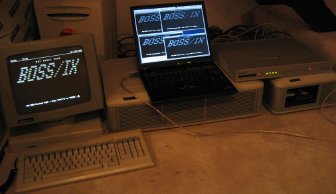 A few years Later, MAI offered a SCSI controller board to support
1/2" reel tapes (Model 4402 Cipher 1/2") also.
A few years Later, MAI offered a SCSI controller board to support
1/2" reel tapes (Model 4402 Cipher 1/2") also.
The operating system was named BOSS/IX and in fact it was UNOS by
Charles River Data Systems (CDRS). MAI licensed the source of
UNOS from CDRS and used it for the sytems 2500,3000 and 4000. I dont
know what have been changed by MAI but at least they added a copy
protection. The machine has the serial number (and some key, to be
verified) in nvram. The serial number could be written by a so
called
ssn-program that the MAI guys had on tape. For later machines, it
was
also required to replace a pal before write access to the serial
number
section of the nvram was granted. In addition there was a config
record
that containd the serial number in a crypted form. Also included was
the maximum allowed memory and later the operating system version.
This
config record had to be saved to disk using dutil that was part of
the
diagnostic tape or during installation of BOSS/IX . Without that
machine specific config record, the
operating systems stopped within the boot process.
However, they had included a lot of stuff from CDRS on the BOSS
tape,
there was a debugger, a c compiler, the menu system including
source,
informix, a pascal compiler and more. Some packages (i remember the
pascal compiler) were protected by a key that had to be stored in a
file. This was a to simple appoach, the pascal compiler generated
the
needed key and compared that key to the one in the keyfile, both
keys
where in memory where it could be seen by the debugger.
In 1984, cost for that machine ranged from $14,000 for a basic
system
to $62,000 for a complete system with 2 disks a 240MB, the external
45MB 1/4" streamer, a printer and 8 Terminals.
The system i worked with was equipped with 2 Rodime 20 MB disks, 1
MB
of memory and the standard 45 MB Tandberg 1/4" streamer. The system
was
equiped with 5 terminals (3 Qume QVT101, one MAI S/10 and one ICL
Terminal and two printers (parallel OKI82 and serial OKI192).
The software was witten in MAI basic, initially on an S/10, later
developed on the system 2000.
I few years ago i got a working system 2000 but unfortunately
without
the BOSS/IX tape. I'm searching for a tape or the contents of the
tape
for BOSS/IX release 7.5B*22. If you have such a tape or know someone
who could help, please contact me. My email-address is at the end of
this page.
This machine came with 2 4 ways, a MCS controller and 2 maxtor
drives. The drive for booting the os
worked but the second one was dead. So the first action was to do a
backup of the working disk. Then i saw that this disk also sometimes
had read errors so i had to replace it. I searched a while on ebay
and
got 2 3 1/2" seagate 80 MB MFM disks. I have the diag tape but the
program dutil (needed to format the disks) only supported the disk
models sold by MAI at that time. I used a linux machine to read the
contents of the diag tape. The programs where stored in motorola
s-records format. I wrote a small hack in pascal to patch another
disk
format into dutil and was able to format the "new" disks and finally
restored the contents of the original boot drive. Sice MAI was
paranoid
againsed copying their software it took me some time to restore the
so
called "config record". This disk sector contains a cryped record
with
the serial number of the machine, the maximum licensed memory, max #
of 4 ways, enabling of floppy, #of MCS boards ....
I have scanned the service manual for the machine and the tape drive
as
well as the error logging manual that survived over the years. These
documents are available at bitsavers.org.
I have some more manuals waiting to be scanned.
2500 - year? BB7 MAI SPX (BOSS/IX)
The MAI 2500 was a replacement for the MAI 2000 based on the MAI
3000
hardware. It used the same cabinet as the 3000. BOSS/IX 7.4B was
the fist version that supported the 2500.
I do not have any information or manuals for the system 2500.
1500 - 1986 (BB6)
This was a 80286 4,77 or 6MHz) based machine running MSDOS 3.2 or
BOSS 6.2 (BB6). BB6 was a
multi-user operating system with Business BASIC integrated into the
O/S. BB6 was similar to BB/M and BB4. The system supported the
console
and 2 additional serial connected termonals. Later there was a multi
port serial board available to support more than 2 serial terminals.
I do not have any information or manuals for the system 1500.
3000 - year? BB7 MAI SPX (BOSS/IX)
The 3000 was an enhanced 2000 with an 68020 cpu and a coprocessor.
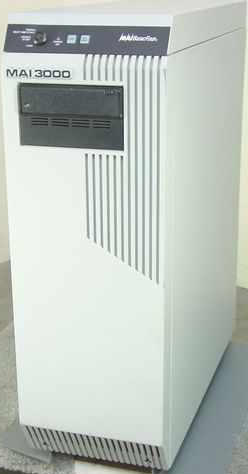 The machine could be equipped with 3 disk internal drives. In addition to
the 4 way controllers of the 2000, there was a new 8 way controller
board (maximum 32 serial ports + 2 on CMB). The streamer was a
internal
1/4" type. Main memory was expandable to 16 MB. The operating system
was the same BOSS/IX as for the 2000. (min version 7.4B)
The machine could be equipped with 3 disk internal drives. In addition to
the 4 way controllers of the 2000, there was a new 8 way controller
board (maximum 32 serial ports + 2 on CMB). The streamer was a
internal
1/4" type. Main memory was expandable to 16 MB. The operating system
was the same BOSS/IX as for the 2000. (min version 7.4B)
The only information i have is an "Error Logging" manual that also
contains a description of the diag tools (same for 2000,2500,3000
and
4000).
4000 - year? BB7 MAI SPX (BOSS/IX)
Model 4000 was an extended system 3000. A model 3000 could be
upgraded
to a 4000. Using a expansion chassis, the system could have up to 7
disk drives as well as additional 4 way controllers. A maximum of 74
serial and 3 parallel ports where supported. Memory was expandable
to
16 MB using new 4 MB memory boards.
I do not have any information or manuals for the system 4000.
Later models
Later models are based on intel CPU's and run BOSS/VX (SCO or AT&T
Unix ?) with open basic by MAI. Thas was called "Dual Universe".
I have two manuals, "BOSS/VX Refernce Manual" and "BOSS/VX System Administrators Guide".
last change Oct 27, 2017 Armin. Impressum